





How to Integrate Drone Shows with Fireworks: Technology, Safety & Event Planning

Drone shows with fireworks are rapidly becoming the preferred format for large celebrations, brand launches, marketing events, national holidays, and destination events. As drone technology advances and control software becomes more accessible, event producers are adopting hybrid formats that combine aerial animation with traditional fireworks, including pyro drones equipped with onboard firework modules. This rise of hybrid drone-fireworks shows reflects a broader shift toward immersive, fully synchronized, multi-technology performances. Organizers no longer have to choose between drones or fireworks; they can integrate both to maximize creative impact while maintaining safety and operational control.
Industry forecasts project the global drone light show market to grow at over 15-19% annually through the end of the decade, with hybrid and pyro-enabled concepts driving demand for premium event experiences. For fireworks professionals already operating pyro consoles, laser systems, or timecode-based show control, integrating drones is a logical next step.
In this article, you’ll learn what defines a hybrid drone-fireworks show, how synchronization and timecode integration function in practice, how pyro payloads are safely triggered onboard drones, and which best practices guide choreography and animation planning. We also cover key safety, regulatory, and environmental considerations, along with real-world examples of pyro drone shows in action.
Why Fireworks Companies are Turning to Drone-Hybrid Shows
For established pyrotechnic operators, using drones in live shows is less about following a trend and more about enhancing an existing show environment.
If you already manage professional fireworks displays, you are familiar with strict safety zones, permits, site inspections, timed cues, and complicated production settings. You know about drone show choreography, synchronization, and how to create a show that reaches emotional highs at the right moments. Those skills easily apply to hybrid drone-fireworks productions.
Why Hybrid Makes Business Sense
First, there’s the business opportunity. Clients are asking for something bigger and more immersive than a standard fireworks display. They want storytelling, logos in the sky, animated symbols, and sponsor reveals, followed by a powerful finale. Drones make that possible. Fireworks enhance it.
Second, hybrid shows allow companies to expand creatively without letting go of what they already do best. Fireworks provide scale, sound, and visceral impact. Drones offer precision, control, and programmable visuals. Together, they create a layered performance that feels cinematic rather than just explosive.
Third, hybrid formats help companies remain competitive. In some locations, environmental and noise issues are becoming more significant. Using drones for narrative segments and fireworks for key moments can provide a more balanced approach that meets both spectacle and regulation.
In advanced formats, pyro drones are drones with small built-in pyrotechnic modules that can fire safe, controlled effects while flying. In a hybrid drone-fireworks show, fireworks provide strong impact, classic celebration energy, and memorable finale moments. At the same time, drone shows add precise 3D animation, logos, and text in the sky, along with repeatable choreography and quieter storytelling segments when needed. That’s why hybrid shows feel different from fireworks-only displays, which have more narrative and structure, and also from pure drone shows, which lack the real fire effects and sounds that drones cannot create on their own.
In practice, hybrid drone-fireworks shows are carried out in several structured ways:
- Parallel integration. Drone formations and fireworks work as synchronized visual layers. Timecode ensures that aerial animations and ground-based pyro cues match the music frame-for-frame. A strong example is PortAventura World, where the nightly production combined 300 drones, fireworks, and water effects into a synchronized show environment.
- Sequential integration. Drone storytelling builds narrative tension using logos, historical imagery, and thematic scenes. Fireworks provide high-energy climaxes or finales.
- Onboard pyro drones. Drones with small pyrotechnic modules create mid-air bursts. This blends controlled ignition with precise flight paths for tightly coordinated fire effects. An example is the City of Irving, TX, where the show featured 25 pyro drones and 500 light drones, demonstrating a mixed-fleet approach (pyro drones + “regular” light drones).
These models differ from traditional fireworks-only events, which mainly focus on explosive visuals. They also differ from pure drone shows, which emphasize quiet precision and animation. Hybrid productions combine both mediums into a unified, time-coded performance.
Pyro Drones Technicalities: Synchronization and Integration Workflows
Integrating drones and fireworks is technically achievable, but it works best when the animation, drone, and pyrotechnics teams plan and coordinate together. Most hybrid productions follow three key steps. First, all systems are synchronized using timecode. Then, fireworks are added either on the ground or onboard (pyro drones). Finally, the timing of the drone choreography and pyro cues matches the music, creating a cohesive show.
Timecode Synchronization Fundamentals
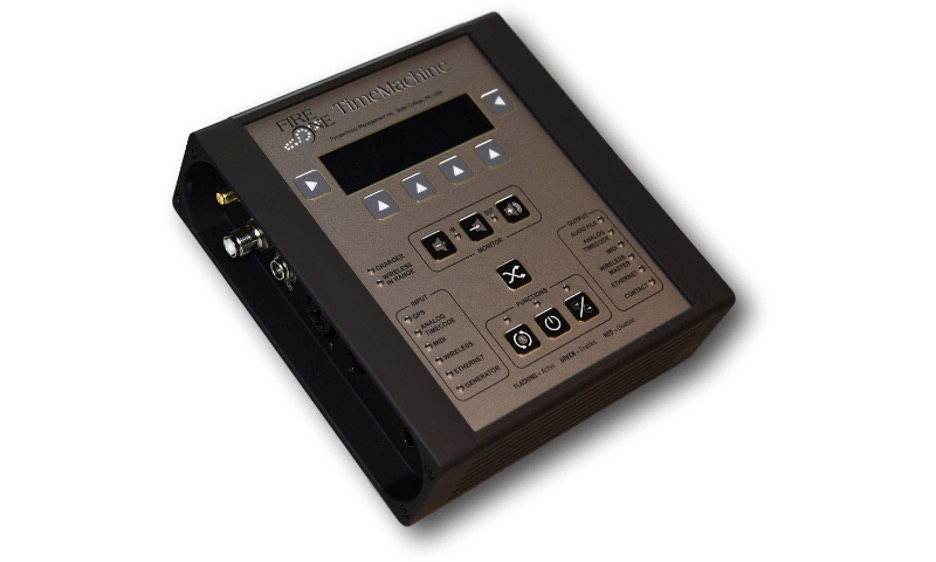
To sync drones with fireworks consoles, lasers, fountains, and music, all systems need a shared time reference. The first Timecode support in Drone Show Software was designed around FireOne TimeMachine, a leading GPS-based timecode generator widely used in fireworks shows.
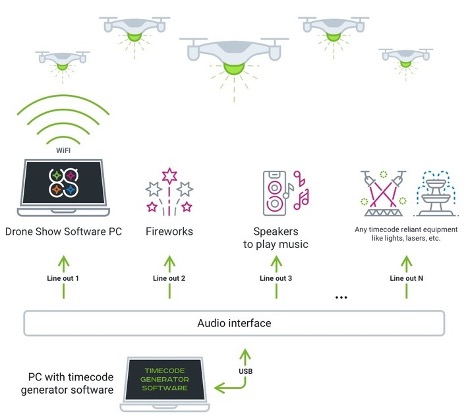
In this setup, the goal was to start all systems in sync, while exact GPS clock accuracy was not critical. That’s why the team chose a PC with a professional multi-output audio interface to distribute timecode. ShowSim 3D on the computer generated the timecode signal, and any timecode-reliant hardware could be connected via the interface.
The key advantage of this configuration is flexibility: each device can receive timecode in the format it requires, whether it’s the fireworks control unit, drones, lasers, fountains, or other show systems.
The agreed approach was to use an audio interface with multiple XLR line-out outputs. One output sent timecode to the fireworks control unit, another to the drone Ground Station PC running Drone Show Software, and a third line output delivered the music track to the amplifier and speakers.
Pyro Payload & Triggering Systems
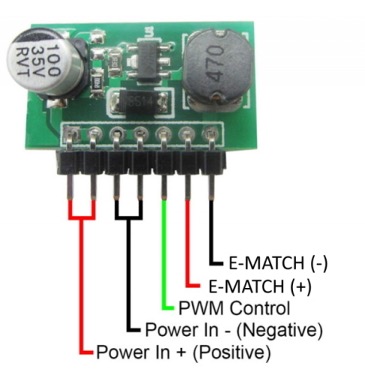
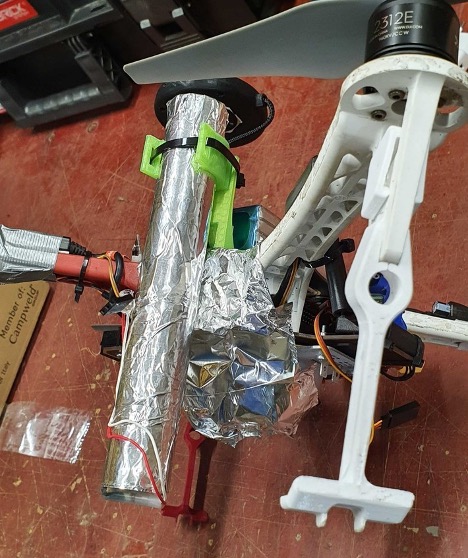
For pyro drones, the onboard ignition system must be lightweight, reliable, and built with redundancies. In this workflow, Drone Show Software's team developed a method to ignite an electric match directly from the drone’s flight controller. The simplest approach was to use an off-the-shelf PWM-based driver, powered by the drone’s 4S battery (~14.2V) and controlled via a PWM signal from a servo output on the flight controller. The electric match igniter is connected to the driver’s output terminals.
To mount the pyrotechnic charge on the drone, the team designed a 3D-printed holder (shown in neon green in the image), with the PWM driver visible on the right.
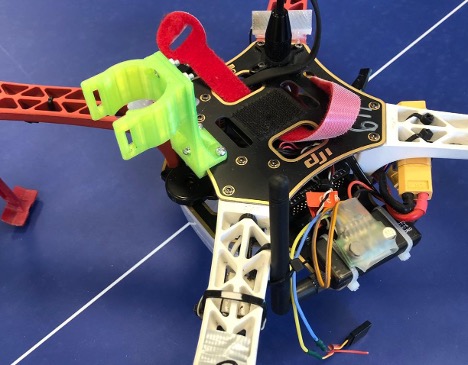
Once the holder and ignition system were ready, the team ran a full pre-show rehearsal: they flew the complete animation, started via timecode, to confirm that the show launches correctly and stays synced to the music, the flight speeds and separation distances remain within safe limits, and the electric match can be triggered reliably at the planned moments.
Drone Display Choreography and Animation Planning
A strong hybrid show is won or lost in pre-production. When you mix drone shows with fireworks, choreography goes beyond nice visuals; it’s the plan that keeps drones, pyro cues, and music connected in one storyline. The goal is to create a clear emotional arc. Drones carry the narrative and precise imagery, while fireworks hit the high-impact moments at just the right times.
Creative planning usually starts with two anchors: the music track, including tempo, crescendos, and accents, and the key story points you want the audience to remember. Once the soundtrack and storyline are approved, teams move into scene ideas and visual design.
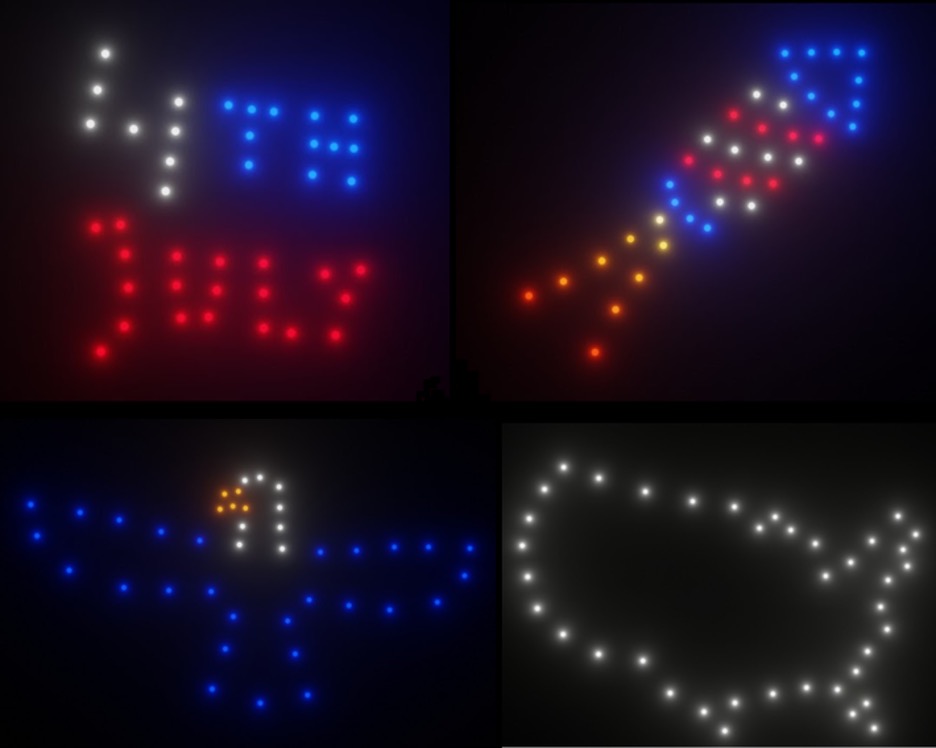
In one example from Independence Day, the animation concepts included a firework symbol, an American bald eagle, the shape of the USA, the Statue of Liberty, “4TH JULY” text, and the US flag. These visuals work well because they are easily recognizable from a distance and remain clear even when fireworks add brightness and motion in the background.
Modern best practices for hybrid choreography
To make a hybrid performance feel cohesive (not like two separate shows running at once), teams typically follow a few proven rules:
- Map visuals to the music first. Mark the intro, build-up, crescendos, and finale. Reserve the strongest fireworks moments for musical peaks, while drones handle transitions, reveals, and narrative beats in-between.
- Design “fireworks windows.” Plan segments where drone formations are stable and predictable, so pyro bursts read cleanly and don’t visually compete with fast drone motion.
- Use contrast on purpose. Drones do detailed storytelling (logos, text, symbols); fireworks deliver impact and scale. Avoid trying to make both the “main thing” in the same second unless it’s a deliberate finale moment.
- Keep formations readable for the crowd. Use simple silhouettes (flag, eagle) around big pyro moments, and save complex imagery for quieter drone-only beats.
- Build choreography around safety. Define altitude bands, spacing, and conservative speed profiles near pyro cues, especially for onboard pyro drones.
Visual preview workflow: from concept to ShowSim 3D to testing
A practical workflow for hybrid show planning typically looks like this:
- Concept sketching and storyboarding
- 3D animation build in Drone Show Software
- Scene timing to music
- Timecode track creation
- Pyro shot planning
- Pre-show simulation in ShowSim 3D
- Full technical rehearsal
Best practice is to treat fireworks as the "punctuation marks" of the show. They provide big emotional moments on the timeline. Drones, on the other hand, carry the storytelling, branding, and precise imagery that make the entire production feel unified.
How Hybrid Pyro Drone Shows Boost Live Events
Hybrid drone-fireworks shows are effective for live events because they turn the sky into an extension of the stage. Instead of treating a drone show as a separate part of the program, event teams blend drones, fireworks, music, and other elements into one coordinated experience, ensuring that sight and sound come together perfectly.
From the crowd’s point of view, hybrids feel bigger for three reasons:
- They create a clear emotional arc. Drones tell stories through logos, symbols, messages, and themed scenes. Fireworks serve as the powerful moments, especially during crescendos and finales. This timing matters: using too many fireworks too early can weaken the ending, but well-timed bursts at critical moments create unforgettable experiences.
- They produce more “shareable” moments. A perfectly timed burst of fireworks framing a drone logo reveal or a fireworks accent hitting exactly when a formation changes creates visuals that people love to capture and share.
- They unify multiple event technologies. When drones and fireworks are synchronized to the same time reference, often using the same soundtrack, you can connect aerial visuals with music, lighting, lasers, fountains, LED screens, and special effects. This way, the entire venue feels like one seamless show instead of separate vendors performing unrelated acts.
This is why hybrids are now common in concerts, festivals, city celebrations, brand launches, and theme-park productions: drones provide structure and storytelling, fireworks bring scale and impact, and timecode ties everything together into one premium live experience.
Safety, Regulations, and Risk Management in Pyro Drone Shows
Running drone shows with fireworks raises safety concerns because you combine aviation-style operational risks with pyrotechnic risks. The goal is clear: even if something goes wrong (like weather changes, GPS problems, signal loss, a misfire, or a drone drifting) the system must fail safely, without putting the crowd in danger.
Hybrid shows begin with careful site planning. This includes clear distances for audience safety, defined flight boxes, no-go buffers around buildings and obstacles, and separate areas for launching, landing, and pyrotechnic operations. When pyrotechnic cues are active, especially with pyro drones, operators often reduce the flight envelope by tightening altitude bands, spacing rules, and speed limits. This ensures that formations remain predictable during ignition windows.
Modern risk prevention depends on layered protections. These include geofencing, real-time telemetry monitoring, health checks for battery levels, GNSS quality, link stability, and a strict go/no-go process. When pyrotechnics are involved, ignition systems should include additional controls, such as arming logic, interlocks, and no-fire settings, to handle signal loss. There should also be clear abort procedures and responsibilities shared between the drone and pyrotechnic teams.
Hybrid productions usually require coordination with various authorities. This includes obtaining aviation permissions for swarm flights, nighttime operations, and proximity limitations, as well as municipal event permits for public safety and emergency services. Pyrotechnic compliance is also necessary, addressing licensed operators, storage and transport rules, and firing procedures.
Real-world incidents
Incidents in recent years have led to increased scrutiny, particularly regarding crowd separation, geofence design, weather limits, and pre-flight validation. For example, an accident in Liuyang, China (October 2, 2025), in which a drone-and-fireworks show malfunctioned, with drones reportedly catching fire and falling, triggering panic and a fire response. Authorities later reported no injuries, but the incident underscored how critical conservative safety perimeters, robust fail-safes, and clear abort authority are when pyrotechnics are in the airspace.
Another notable incident occurred in Melbourne (Docklands) on July 14, 2023. An ATSB investigation found that the swarm faced wind conditions beyond the published limits, and the ground control setup did not actively notify the pilot of those exceedances. In total, 427 out of 500 drones were lost to the water.
The main takeaway for pyro drone shows is simple: treat weather thresholds, perimeter design, software alerts, and abort authority as essential components of the show, not just paperwork.
Examples of Pyro Drone Shows
Here are a few real-world pyro drone and fireworks shows from the Drone Show Software portfolio. Each example highlights a different hybrid format, including large public celebrations, theme-park nightly productions, and advanced onboard pyro drones. This way, you can see how drone choreography and pyrotechnics work together in practice.
PortAventura 30th Anniversary Nightly Drone Show (Spain)
A nightly theme-park production where 300 drones were integrated into PortAventura’s iconic FiestAventura show, combined with fireworks, water effects, and live performances; all synchronized as one show environment.
Let Freedom Sing! Music City July 4th (Nashville, USA)
A large public celebration where 400 drones flew in sync with a major fireworks program, showing how drones can add structured visuals and storytelling alongside traditional pyro.
PABLO AIR Guinness World Record: 1,068 Drones & Fireworks (Korea)
A Guinness World Record performance where 1,068 drones launched fireworks simultaneously in Incheon, combining drone formations with coordinated pyro effects in a single timed show.
Conclusion: From Standalone Displays to Fully Integrated Pyro Drone Shows
Hybrid drone shows with fireworks have shifted from experimental ideas to established event formats, bringing together the strengths of both tools. Drone formations provide precise storytelling, branding, and repeatable choreography. Fireworks create high-energy moments and a powerful finale that audiences expect. When these elements are synchronized using timecode and designed as one timeline, the outcome feels like a single cohesive production instead of two separate shows sharing the same sky.
The key to success is structure. Choose an integration model that suits the event, such as parallel layers, sequential storytelling, or onboard pyro drones. Build the choreography around the music, and incorporate safety planning into the creative process. By ensuring clear safety zones, conservative flight envelopes, reliable ignition logic, rehearsals, and a clear abort plan, hybrid productions can grow from city celebrations to premium venue shows while meeting today’s regulatory and community expectations.
If you’re looking to enhance your fireworks offerings with drones or want a practical path from the initial hybrid concept to a fully integrated production, view our drone shows with fireworks page.


Soar above the rest. Subscribe to our regular news updates